Physical Address
304 North Cardinal St.
Dorchester Center, MA 02124
Physical Address
304 North Cardinal St.
Dorchester Center, MA 02124

The greatest, the least, and others in between.
The greatest, the least, and others in between.
Artificial intelligence has long been part of many industries including fashion, apparel and retail. When generative AI started making waves several years ago, it marked a turning point in what the technology could reasonably be tasked with doing, and threw a wrench into some companies’ future plans.
Image-generation tools have started to become fixtures in the fashion and apparel communities for a variety of tasks, including designing new garments. But the instances of AI-aided collections being brought to the fore in denim have been few and far between.
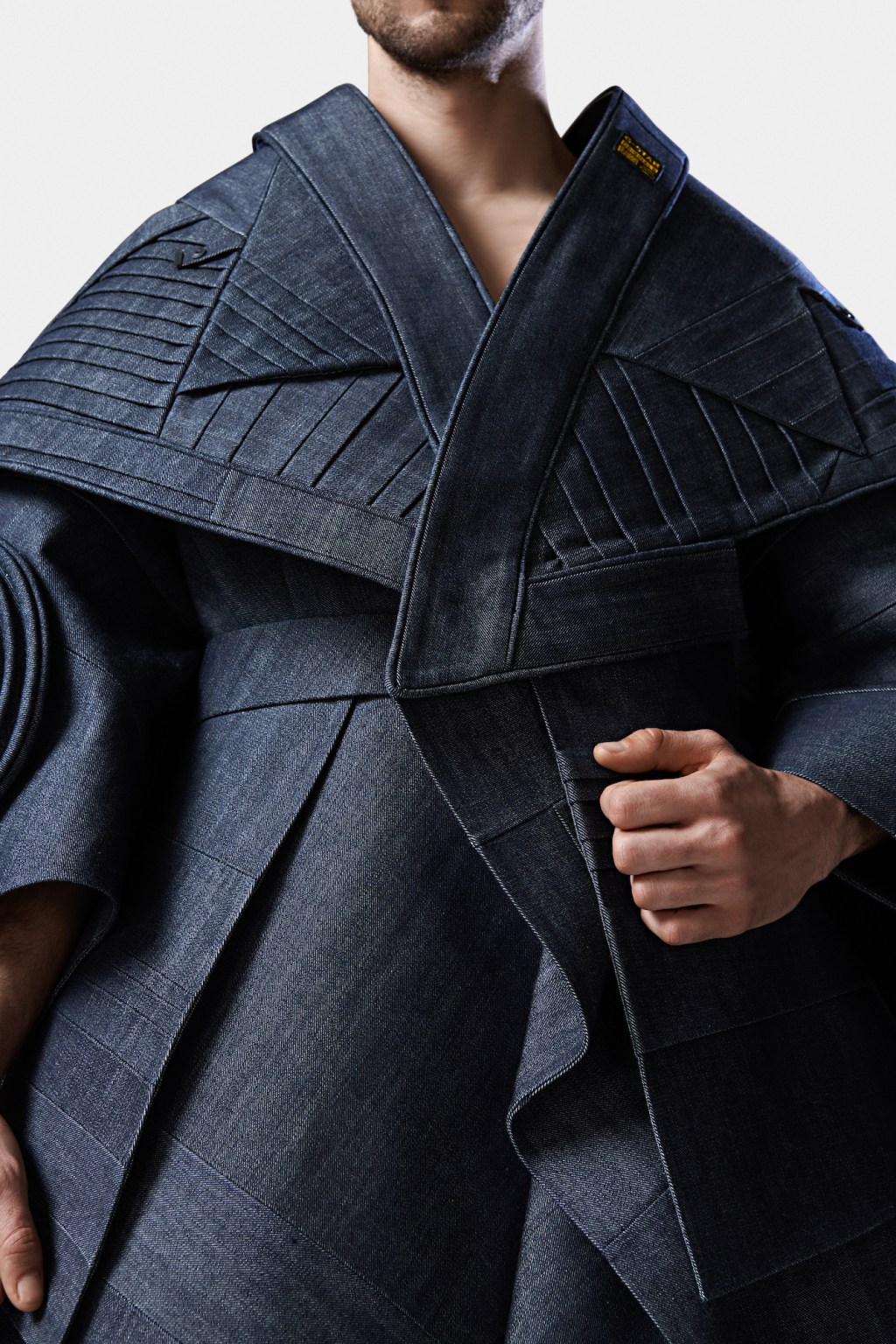
In 2023, G-Star Raw released its first AI-aided denim couture piece, a cape with sharp corners, intricate stitching and a fantastical shape. The cape was just one physical item produced from a broader, otherwise digital-only collection that featured a variety of images that displayed how generative AI can be used for design.
Gwenda van Vliet, G-Star’s chief brand officer, said the collection—and particularly making a physical version of the AI-inspired cape—gave G-Star’s designers and employees a glimpse into the future, as well as a chance to learn more about generative AI’s influence.
“We embrace everything that’s happening [with technology], but we also understand, OK, we need to make something with it, because otherwise it’s just out there and it doesn’t do anything. And to change the industry, we always want to make sure that we can create something out of it—something real,” she explained.
Meanwhile, global denim manufacturer Soorty released two AI-aided collections in its HumAIn series, which featured both digital-only assets and physical garments.

Soorty
It partnered with Volker Ketteniss, founder of ORNMNTNCRM, for the first HumAIn collection, and with Amy Leverton and Shannon Reddy of Denim Dudes for the second iteration. Like G-Star, the vertical manufacturer did not sell the physical garments that resulted from the AI collections.
In large part, the holdup over selling AI-aided designs has to do with the intricacy of the stitching, pattern making and dyeing required to bring AI-imagined garments to life at scale. Eda Dikmen, senior marketing and communications manager for Soorty, said, for AI-aided collections to be produced with any real cadence, they would need to be far less ornate.
“We produce at scale, and these [pieces] require very detailed production, so you have to work very closely with the garment—not just the laundry, but the stitching,” Dikmen said. “Our ordinary days are very time focused, and everything has to be optimized…The [physical garments from the HumAIn] project really needed to take more time,” she said.
For some brands, experimenting further with AI for design or imagery may feel like a risk; earlier this year, dress brand Selkie faced serious consumer backlash for disclosing it had launched a Valentine’s Day collection with AI-designed art. And Levi’s has, in the past, taken heat for a short-lived decision to test AI-generated models for product imagery.
From a sustainability and cost standpoint, some of the risk associated with designs made in part with AI could be mitigated by producing garments after they have been purchased.
Resonance, a company which allows designers and brands to design their own garments for made-to-order production, uses AI to make production more efficient and sustainable, since items are only made when demand exists. Kerry Steib, head of brand and marketing for Resonance, said that helps brands ensure they create as little waste as possible.
“Leveraging AI systems will enable us to better identify opportunities for us to minimize waste…and then to enable brands using our platform to take advantage of that,” Steib explained.
Partnering with an on-demand manufacturer could mean garments wouldn’t need to be produced by the thousands, but it doesn’t yet solve for the fact that fantastical designs can be difficult to manufacture efficiently.
Ketteniss said manufacturing isn’t the only part of the process that can prove time consuming; designing with AI also takes longer than meets the eye. For Soorty’s first HumAIn collection, he used Stable Diffusion, a more complex open-source generative AI model that allows users to tweak individual elements of a design in real time.
“With Midjourney, you can fairly easily make [images] that look pretty good, but they’re not so easy to control. You can get loads and loads and loads of images, but at some point, you want to control what you’re doing,” Ketteniss said. “Stable Diffusion…will give you other levels of control, so you’re not just exposed to whatever it gives you, but you can actually be much more specific.”
For its preliminary foray into AI design, G-Star used open-source model Midjourney, which is a bit less technical and can enable a more accessible experience for first-time AI users.
Having learned from its initial work with generative AI, G-Star has begun training Stable Diffusion on 25 years’ worth of its own collections. Nicolas Griffioen, new tech lead at G-Star, said the brand wanted a way to bring its identity to its newest AI-inspired creations, beyond relying on an open-source model alone.
“AI has a reference of what denim looks like, of what it could be, but [when] matching that to what G-Star thinks it should be, there was a gap,” he said.
Already, training that model—and teaching G-Star’s designers to use it—has yielded some fruitful results for the brand.
“The first AI designs are on the market, actually. We’re testing them now, and they are pretty successful, which is nice to see. It’s really a process, and we believe that step by step, [AI-aided designs] will become a bigger part of the collection, van Vliet said.
But van Vliet said the designers won’t soon be abandoning their own creative roots; they use a mix of technology-forward programs and traditional design methods, like sketching, making mood boards or otherwise, in the atelier.
The brand does not outwardly indicate that an item has been created with the help of AI, so van Vliet said she couldn’t say for sure whether AI’s influence in design directly impacts consumer purchasing decisions. However, she noted that because G-Star’s consumers tend to seek out pieces that stand out from others, the unique nature of the AI-inspired pieces has shone through, garnering sales.
Though Soorty hasn’t taken the same route as G-Star when it comes to scaling AI designs for production, Dikmen said it’s not out of the question that it could do so in the future. Currently, though, Soorty—like many other brands, retailers and manufacturers—has honed its focus on what the technology can do for its internal operations.
Some brands and retailers—G-Star included—have also adopted more practical use cases for AI that come along with more immediate business benefits. Common generative AI-powered integrations include front-facing product imagery enhancement and upgrades to customer experience, though a slew of companies have leaned into the technology’s supply chain abilities more readily.
Ketteniss said design continues to be an area of interest for players throughout the denim industry, but the technology has not yet been refined enough to create meaningful, complete designs with AI.
“The projects that I’ve done, they’ve been a mix of things—a bit of Photoshop, and not pure AI. If you want to go further—beyond the point of, ‘Oh look, this is interesting,’ to the point of, ‘This is actually usable and it works,’ I think you’re probably still working with more than one tool,” Ketteniss explained.