Physical Address
304 North Cardinal St.
Dorchester Center, MA 02124
Physical Address
304 North Cardinal St.
Dorchester Center, MA 02124

The greatest, the least, and others in between.
The greatest, the least, and others in between.
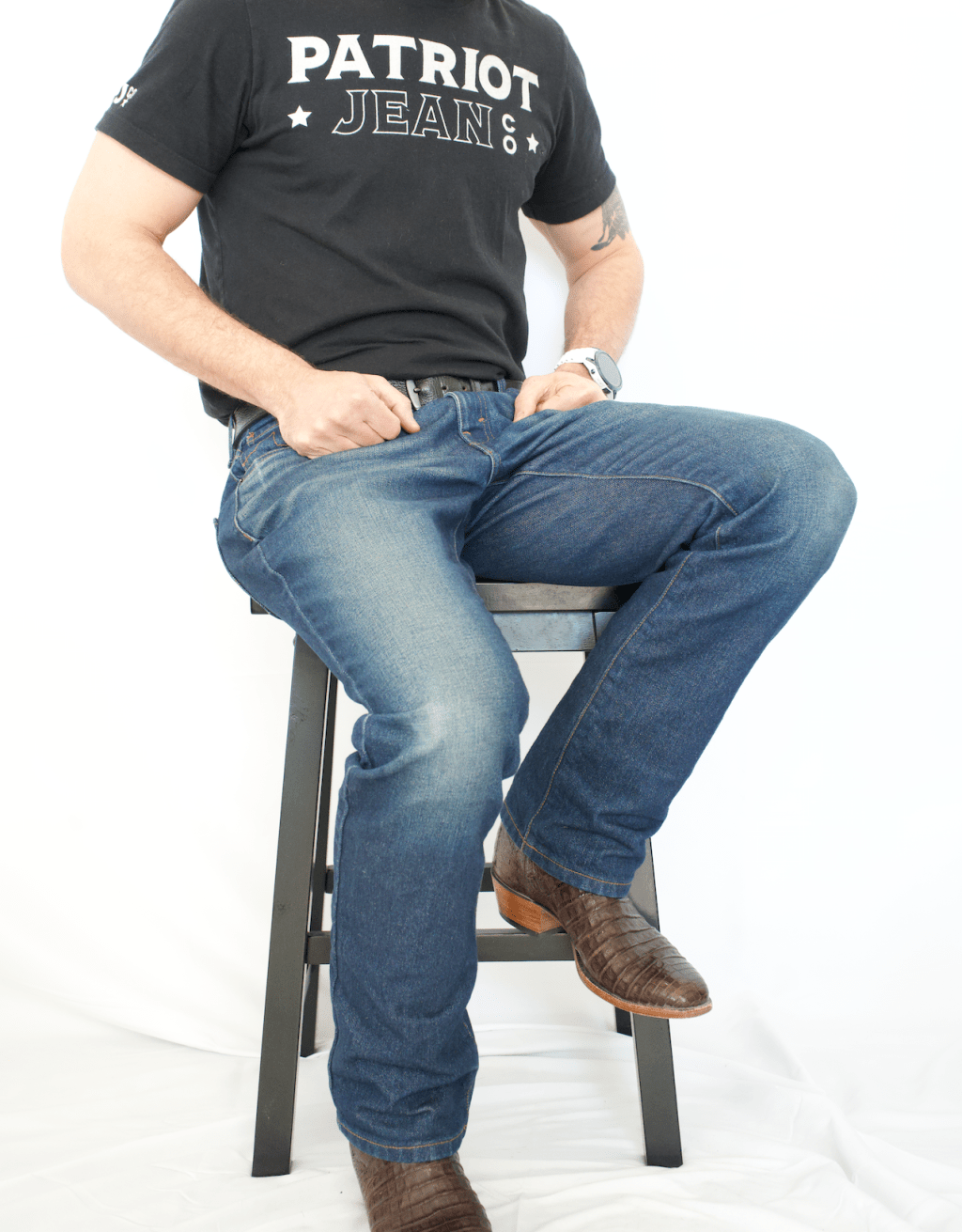
Patriot Jean Co., a new direct-to-consumer men’s denim brand, is stepping in to fill the void left in the U.S. market when the denim industry’s “big three” shifted their production overseas.
“In my research, I found that 450 million pairs of jeans are sold in the U.S. every year, but less than 3 percent are made here. That told me there’s a lot of volume and a lot of demand for jeans. It also told me even though it was a very low percentage—some people claim as low as 1 percent—that with grit and determination, a good plan and good suppliers, making jeans in America is possible,” said Patrick Mate, founder of Patriot Jean Co.
Becoming an entrepreneur in the fashion industry was an unexpected shift for Tucson, Ariz. Mate. After serving five years in the U.S. Army, he transitioned into engineering, working as a contractor for both small businesses and large corporations. However, it was during the pandemic, as consumers reevaluated their work-from-home wardrobes, that Mate recognized a gap in the market—the challenge of finding classic blue jeans made in the U.S.
“Being at the executive level, I realized I could wear a sport coat on zoom calls, but I didn’t have to wear dress pants. And so, I thought, let me go out and buy a couple of good pair of American made jeans. And that’s where I really struggled. I couldn’t find anything that I really liked. Most jeans were not made the U.S. And secondarily, it seemed like most of the options had some type of stretch denim. The jeans resembled more of yoga pant than just a traditional, good American made pair of jeans that I was used to growing up,” he said.
Like many, the pandemic led to a major career shift for Mate. “Frustration breeds innovation. Frustration breeds entrepreneurial spirit. When I couldn’t find something of good quality and made in the U.S.A, I decided to do something about it,” he said about his unexpected foray into jeans.
He dedicated an entire year to immersing himself in the denim industry, admitting that at the time, he “knew absolutely nothing about denim.” To gain a deeper understanding, he conducted extensive market research, sought mentorship from experts in both entrepreneurship and apparel, and completed the Denim 101 course offered by the White Oak Legacy Foundation in Greensboro, N.C., which is held twice a year.
Mate began connecting the dots. Patriot Jean Co. sources fabrics from Mount Vernon in Georgia. The jeans are stitched in Texas. He partnered with Christine Rucci, denim expert and founder of Godmother NYC, Inc., to develop fits.
Patriot Jean Co. launched online 15 months ago with unisex T-shirts and hats. Jeans were added last November, debuting with an athletic fit and “refined fit” with a tapered leg that can be dressed up. Mate is working with Rucci on a third “true relaxed” fit that will launch later this year. “A lot of our customers have been asking for something a little bit bigger, so this will satisfy that end of our demographic,” he said.
“What we really strived for is to put together a timeless quality pair of jeans,” Mate added. The brand selected a 14.75 oz. broken twill cotton denim fabric for its base fits. “It is something that is super strong and durable, and has just a little bit of flair, rather than a typical three by one left hand weave. You get some intricacies with the broken twill that you normally don’t get. Our customers have loved it so far,” he said.
The jeans retail for $114-$119. Mate is bullish about staying on the D2C course. “We want to stay direct to consumer. It gives us the ability to shape the brand and work directly with our customers and get that feedback and offer our customers the lowest possible price,” he said. “I don’t foresee that we’ll ever be on Amazon.”

Patriot Jean Co.
You might find the brand on Linkedin, however. The business-oriented social media platform has been an unexpected driver of sales and a gateway to new likeminded customers. “We’ve got a strong following now on LinkedIn of folks who like the idea that their money is going to support American workers and American farmers and American factories,” Mate said.
Mate recognizes the same gap for domestically made jeans exists in the women’s market. However, his focus for the next two years is to solidify Patriot Jean Co. as a brand, “get into a consistent production flow where the company can start realizing some efficiencies” and generate the needed capital to be able to investigate the women’s market.
To help the self-funded company get off the ground, Mate plans to forgo a salary the first two years. To be a “true to Made in USA brand” down to the zippers, buttons, rivets, labels and shipping boxes, he said the company has been able absorb some minimum order quantities. In some cases, the order was 100-times what the brand needed for its couple of production runs. “We’ve been able to do that, and now we have some trim for the next 10 production runs and we’re okay with that. We’re in it for the long term,” Mate said.
Meeting minimum orders as a startup is one hurdle that Mate can navigate. Other challenges are beyond his scope of control. Mate said he would be in favor of the U.S. government “closing the de minimis loophole” to prevent low quality jeans being sold for substandard prices. The diminishing number of textile mills in the U.S. is also alarming. “Although we love our relationship with Mount Vernon—they’ve been absolutely amazing to work with—it is concerning that they’re the last one standing, as far as the denim mills are concerned,” he said.
“Made in USA” businesses have a lot go gain if there was greater consumer awareness about the positive benefits of buying domestic, he added.
“We are made in USA, but non-political in nature,” Mate said. “What I can say is that ‘made in USA’ has been resonating. There’s a reciprocal benefit of when you spend local. For every manufacturing job that is created in the United States, there are approximately two additional jobs in other markets created.”
Additionally, the sustainable benefits of producing and shopping local are often overlooked. “The average pair of jeans sold the U.S. travels over 17,000 miles on its journey of being created before it reaches the customer in the U.S. Think of all the harm to the environment from shipping and trains and trucks—all that logistical footprint. With our jeans, we can map out exactly from coast to coast, and majorly within the southeast United States, of where our denim jeans go before it reaches the customer. And the footprint is astronomically smaller,” Mate said.
Though creating an all-American supply chain is challenging, but Mate said there’s an eagerness to make it a reality. “We struggled with finding a Made in USA supplier for one part of the trim, so we ended up working with a factory that shipped equipment back from an international location and set up a [domestic] product line just to be able to support the production of our team,” he said. “It’s been amazing. Our supply chain team is fully bought in and very excited about the way forward.”