Physical Address
304 North Cardinal St.
Dorchester Center, MA 02124
Physical Address
304 North Cardinal St.
Dorchester Center, MA 02124

The greatest, the least, and others in between.
The greatest, the least, and others in between.
Companies are now required to trace their supply chains all the way back to the raw material. And while this means suppliers need to answer to their partners; it also means that brands and retailers should support those vendors to help them get there.
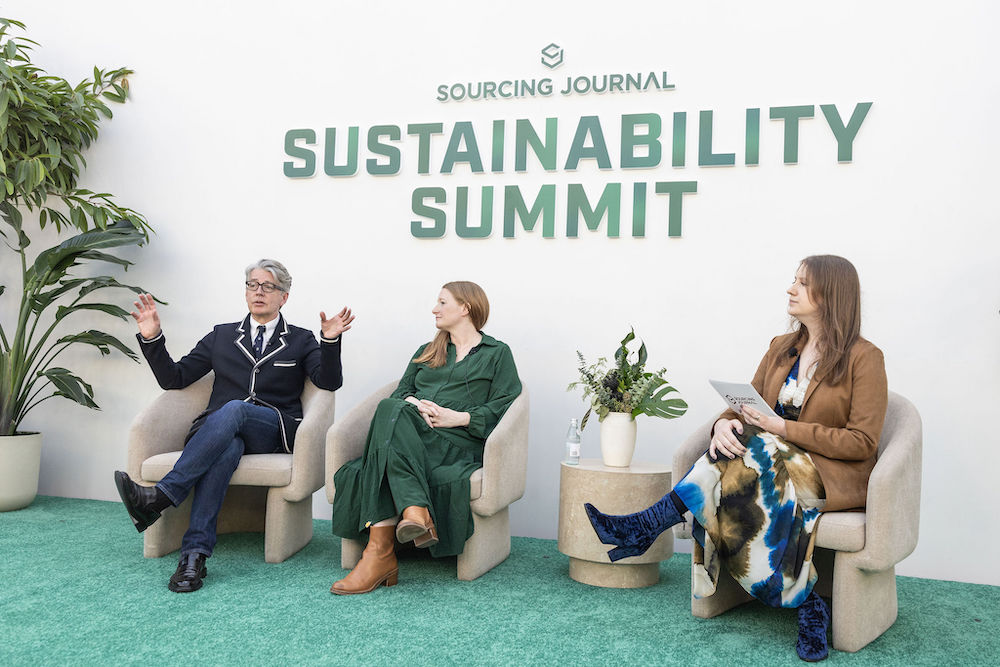
“At the very foundation of it, we have very explicit policies that we’ve set for our partners that say, ‘transparency is not optional to do business with J.Crew Group, it is our expectation,’ and we clearly outline what that means for us,” said Katie O’Hare, vice president, sustainability J.Crew Group at the Sourcing Journal Sustainability Summit in New York.
But rather than try to catch suppliers unaware, O’Hare noted that J.Crew Group “takes it a step further” and works with suppliers to make sure they are ready to provide documents when asked. “We go out to all of our supply chain partners and ask them to help us learn about where our materials are coming from by disclosing deeper tiers in their supply chain and also uploading country of origin documentation for us,” she said. J.Crew then does isotopic testing to ensure that all the “robust information from vendors” is verifiable and the documents accurate.
Among the materials J.Crew sources is Supima cotton. The Pima cotton organization launched the AQRe Project traceability platform in 2023 (standing for Authenticity, Quality and Responsibility) to track its cotton, welcoming the opportunity to learn how its own partners were using cotton and to help support their traceability journey. AQRe leverages Oritain’s forensic testing and TextileGenesis’ blockchain to ensure authenticity and transparency.
“There are half a million bales [of cotton], each weighing 500 pounds, that were harvested and produced each year, and they just kind of flew off through the ether,” said Buxton Midyette, vice president, marketing and promotions, Supima. “[Before], we didn’t have visibility where they landed. But finally, we’re seeing the bales that are being uploaded to the [AQRe] platform and being bought by the spinners and really starting to march fully through the system. It took some time, but it was a good opportunity to get to know each other on a deeper basis.”
J.Crew also welcomes this transparency and traceability. “The combination of the paperwork and traceability through a platform like TextileGenesis, together with isotope testing gives us—and regulators—that extra confidence that…the cotton is actually coming from where we say it is,” said O’Hare.
J.Crew group metaphorically gets its hands in the dirt working directly with partner farmers helping them transition to regenerative agriculture, and this “circumvents the opaqueness of the supply chain.”
“Cotton is not just a nice to have, but it’s critical to the success of our business,” said O’Hare. “If we can’t get good, responsible cotton, then that impacts 70 percent of our products.”
J.Crew also worked closely with suppliers to understand their challenges of producing documentation on cotton that wasn’t just purchased six, 12 or 18 months ago, but was grown even further back. What they found was it was rare to find a supplier who was unwilling to partner with them on traceability. More commonly, they just didn’t know what J.Crew needed or how to get there.
“We had to kind of shift our thinking in terms of ‘we need this now,’ to figuring out, in partnership with our vendors, what is the best system that we can set up to get the information that we need accurately go forward? It’s less of a ‘Gotcha! You don’t have it right now!’ exercise, but more of a we’re in this together. We are partners.”