Physical Address
304 North Cardinal St.
Dorchester Center, MA 02124
Physical Address
304 North Cardinal St.
Dorchester Center, MA 02124

The greatest, the least, and others in between.
The greatest, the least, and others in between.
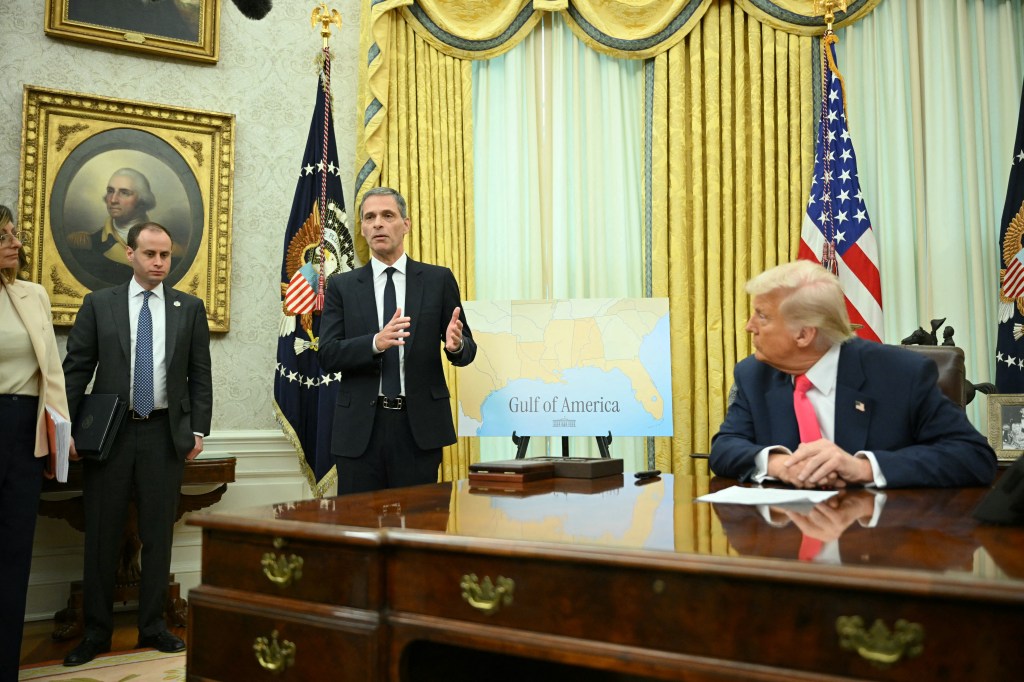
A European shipping magnate doesn’t want to be left treading water when it comes to coordinating logistics operations in the U.S.
French shipping tycoon Rodolphe Saadé, CEO of CMA CGM, stood with U.S. President Donald Trump at the White House on Thursday to announce that the company will invest $20 billion in logistics, shipbuilding and supply chain upgrades in the U.S. over the next four years.
Saadé said Thursday the funds will be used to create 10,000 American jobs.
The announcement came just days after Trump proclaimed in his address before Congress that he would create a U.S. shipbuilding office, targeted at revitalizing the struggling industry in the country.
In a video posted to the White House’s X account Thursday, Trump said he plans to continue working toward that goal. The partnership with Saadé appears to be the latest effort to move in that direction.
“We lost our way—for many years, we haven’t done anything. We used to build a ship a day, and now we essentially don’t build ships. We’re going to start that, and we’re going to be announcing, next week or the week after, a massive new program for building very large, the largest ships in the world,” he said.
The Trump administration is also taking public comments on regulation that would see companies operating China-flagged ships, China-built ships and China-operated ships paying exorbitant fees upon calling at U.S. ports.
Linerlytica data shows that more than one-third of CMA CGM’s current fleet was made in China, and that the company has placed about two-thirds of its new order capacity with Chinese shipyards. According to the Wall Street Journal, Saadé said the regulation the U.S. Trade Representative has proposed would “harm business and global trade.”
Shipping experts have agreed with that sentiment, and have told Sourcing Journal that, if implemented, the move has the potential to implode the industry and is unlikely to cause an increase in shipbuilding orders headed to the U.S.
That regulation, if enacted, would also see certain percentages of U.S. exports required to be carried by U.S.-flagged ships in the coming years. Today, U.S. ships account for a very small portion of the total container ships transporting goods.
During his engagement with Trump, Saadé committed to triple the number of U.S.-flagged ships CMA CGM operates.
“We would like also, Mr. President, to go for more U.S. flag vessels,” he said. “And we will go from 10 that we operate today, to 30 US flag ships, and hopefully, doing more in the months to come.”
CMA CGM owns American President Lines, which operates nine of its U.S. flag ships today.
During the meeting, Trump lamented that some shippers use Panamanian flags or Liberian flags, rather than U.S. flags, on their ships. Saadé told the president that CMA CGM will lead the charge on transitioning fleets to U.S. flag ships.
“This will change, Mr. President. You will have more ships with U.S. flag as we move forward, and you can count on us to do as much as we can,” he said.
In an announcement, CMA CGM said it will use the funds to advance Trump’s shipbuilding aspirations and build out a more robust logistics landscape in the U.S. It plans to develop new infrastructure at various U.S. ports, including New York, Los Angeles, Dutch Harbor, Houston and Miami.
But the company’s investment isn’t limited to container shipping; per the announcement, it also plans to fund an air cargo hub in Chicago, where it will house five Boeing 777 freighters with American pilots in an effort to “strengthen U.S. trade and connectivity and ensure the reliable transport of critical and time-sensitive goods.”
And, true to Trump’s goals of remaining competitive with China on artificial intelligence and automation, CMA CGM has committed to setting up a research and development facility in Boston, where it will work to develop and deploy relevant robotics and automation systems. The company contends that, in doing so, it will be able to increase quality of service and the caliber of logistics services nationally.
According to the Wall Street Journal, the investment will be split into parts: $8 billion for container ships, $7 billion for general logistics, $4 billion for ports and $1 billion for air cargo.
Saadé is far from the first ultra-wealthy international businessperson to join Trump for a funding infusion announcement. This week, the CEO of Taiwan Semiconductor Manufacturing Company (TSMC) announced the company would pump $100 billion into the U.S. to build five new chip manufacturing facilities. Late last year, before Trump’s second term began, Masayoshi Son, CEO of SoftBank Group, joined the now-president at his Mar-a-Lago estate, where he said he would push $100 billion into the U.S. economy, aimed at furthering the development of AI.