Physical Address
304 North Cardinal St.
Dorchester Center, MA 02124
Physical Address
304 North Cardinal St.
Dorchester Center, MA 02124

The greatest, the least, and others in between.
The greatest, the least, and others in between.
President Donald Trump’s long-awaited reciprocal tariffs announcement is imminent, and Democratic lawmakers are making last-ditch effort to mobilize support against new duties on trade allies.
As of the time of this publication, Senator Cory Booker (D-N.J.) remained on the Senate floor in a near-day-long filibuster of sorts, railing against the Trump administration’s domestic and foreign policies that he said have hurt and will continue to burden Americans, including “launching a trade war on our allies.”
“In just 71 days, the president has inflicted harm after harm on Americans’ safety, financial stability, the foundations of our democracy, and any sense of common decency,” Booker said in his introductory remarks Monday. “These are not normal times in our nation. And they should not be treated as such in the United States Senate.”
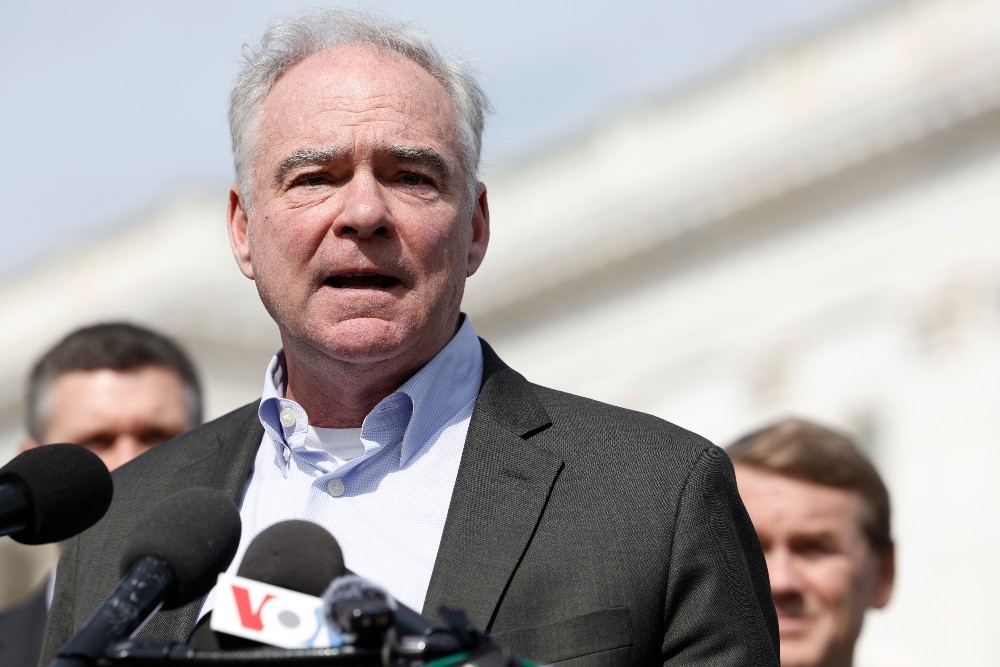
In a bid to stave off new duties on Canadian imports and resuscitate a trade relationship that has taken a beating in recent weeks, Senator Tim Kaine (D-Va.) also pushed to force a vote on a bill that would unravel Trump’s executive order. While the implementation of the 25-percent duty scheme—which Trump claims would address the movement of migrants and fentanyl over the Northern border—has been pushed out twice since it was announced in February, that deferral period ends Wednesday.
Kaine’s bill aims to terminate the executive powers invoked by the president under the International Emergency Economic Powers Act (IEEPA). The lawmaker, who said the legislation would likely come to a vote on Tuesday or Wednesday, called Trump’s reasoning for levying duties a “fake Canadian emergency” and “a sham.”
The bill’s chances of passing in the Senate and the Republican-led House are slim, Kaine acknowledged, but the movement has generated some support from GOP colleagues like Sen. Susan Collins (R-Maine), Sen. Thom Tillis (R-N.C.) and Sen. Rand Paul (R-Ken.), who Kaine said would vote to stop Trump’s tariff plans.
Balanced trade, not reciprocal tariffs, is the right path forward not just for America’s foreign policy and global relationships but for the country’s economy, according to research from the American Economic Liberties Project’s Rethink Trade program.
According to a white paper released this week, the U.S. has operated under a persistent trade deficit with the world since 1975—the result of government-led policies that have favored the country’s financial sector, ultimately leading to slow and steady deindustrialization. Free-trade-centered policies (perpetuated by both parties at different times) have incentivized companies that make their money in America to offshore operations, seeking cheap labor and production costs to pad their margins, the group’s research said.
“This was a bargain that was made in the ‘90s, in which the U.S. basically said, ‘We’re going to give other countries free-market access—or almost free-market access—to sell to the U.S. market, but we’re going to get some things in return,” said Daniel Rangel, the group’s research director.
Those trade-offs included financial liberalization privileges for American firms to operate anywhere they wanted in the world with certain guarantees of success due to the power and prominence of the U.S. dollar. “So coming out and saying that the rest of the world has been so unfair and is taking advantage of the U.S.”—as Trump has done repeatedly since he returned to office—“doesn’t recognize how this was a bargain that was led by U.S. policy,” Rangel said.
While the current administration’s narrative purports that the U.S. is being fleeced by the rest of the world (and it does have the largest chronic trade deficit, at $1 trillion), it’s far from the only nation operating with a trade imbalance, Rethink Trade’s data showed. Today, 66 nations across the globe have trade deficits with their trading partners, while just 19 have surpluses that aren’t related to oil or gas exports.
Rebalancing global trade would require action against the largest of those “mercantilist nations,” which have designed policies that boost their industrial exports through state-sponsored activities and currency manipulation, putting competitors at a disadvantage, Rangel said. “If the policy makers of a country can keep their currency under value, that gives that country an unfair trade advantage,” he said by way of example, also pointing to “any kind of labor regime that suppresses wage growth.”
By interfering with fair competition, as a country like China has done, a large economy can “generate disequilibrium in in the international economy,” Rangel said. While many nations, especially developing economies, have used such policies to “catch up” to their peers on the global stage, “when an economy becomes a developed economy and keeps using them, it generates a lot of global imbalances.”
But seeking to rebalance the scales by targeting nations with tariffs indiscriminately won’t work, Rangel opined. Instead, U.S. government leaders would do better to explore a combination of monetary, financial and trade policies to rectify the deficits. “Tariffs, if applied consistently and in combination with other policies, and ideally in coordination with other deficit countries, could be part of the remedy,” the research said.
“The best case scenario (which is honestly something that’s kind of hard to envision right now, given the chaotic approach that this administration has taken with regards to tariff policy), would be to try to generate some kind of global agreement in which the countries that have seen their industrial capacity diminished, that have seen rising inequality, that have seen huge levels of informality in their economy, could come together and say the current status quo is clearly not working for the majority of our citizens, and we need to come up with something different,” Rangel said.
That new order could involve implementing a two-tier system in which certain countries agree not to use mercantilist tools to advance their economic interests, as well as agreeing to slap countries that are engaging in anti-competitive practices with punitive duties. “The idea would be to try to come up with an agreement that forces a rebalance, and tariffs could be part of the toolbox,” he added.
While Trump has claimed tariffs as the centerpiece of his economic plan, they’re not at all novel, Rangel said. During the 1950s and 1960s, considered by many to be America’s manufacturing heyday, the U.S. had an average tariff rate of 10 percent. That number has declined over the ensuing decades; in 2023, the average U.S. tariff on all imports was 2.4 percent, while the average U.S. tariff on dutiable imports was 7.4 percent, according to the Peterson Institute for International Economics.
“Now they’re being used in a much more aggressive way and with potentially very different objectives than the ones that have been traditionally being linked to this policy tool, in a manner that we can call ‘unprecedented,’” Rangel said.
But in the absence of a formalized tariff plan, the impacts of Trump’s April 2 “Liberation Day” are yet unknown. “It really depends on what happens; if the announcement is about charging reciprocal tariffs to a couple or even a dozen of countries that represent most of the U.S. trade deficit, which has been floated around, the impact will be less severe,” he added. By contrast, if Trump makes good on his stated plans to go global on duties, “the impacts are likely to be felt sooner rather than later,” he opined.
Depending on when the tariffs are ultimately implemented, companies may have time to shift their supply chains to limit the new duty burden—or, the U.S. could see massive market disruption within days or weeks. On Tuesday, the White House indicated that duties announced this week would go into effect “immediately.”
Even if the president’s bark is worse than his bite in this regard, and the tariffs are not as wide-ranging or far-reaching as he’s threatened, the impacts of months of tariff turmoil may be felt for some time. “There’s lasting damage domestically, in terms of delegitimizing a trade tool that has been used for decades,” Rangel said. Tit-for-tat trade wars could become the status quo, even though countries have been taxing imports, to some degree, for generations.
“And we have seen a lot of people understandably worried about how very aggressive and unpredictable tariff policy could affect their lives, so that that could create lasting damage,” he added.
In the near term, new duties run the risk of driving up prices at retail and fueling the inflation that was just starting to cool when Trump took office. “On the domestic front, tariffs could risk a wave of price gouging by corporations with market power that could use the import duties as an excuse to raise prices and bolster their profits,” Rethink Trade’s research said.
“That’s definitely a possibility, and it’s something we’ve already started to see,” Rangel told Sourcing Journal.
“It’s important for people to realize that tariffs are not consumption tax; they’re a tax that is charged when a good is imported into the country by a wholesaler or by a manufacturer,” he said. “This is important, because in the end, a lot of these companies have huge markups, and if what they’re trying to do is to translate any kind of tariff increase to the consumer, that’s a choice that companies are making. That’s not something that they have to do.”