Physical Address
304 North Cardinal St.
Dorchester Center, MA 02124
Physical Address
304 North Cardinal St.
Dorchester Center, MA 02124

The greatest, the least, and others in between.
The greatest, the least, and others in between.
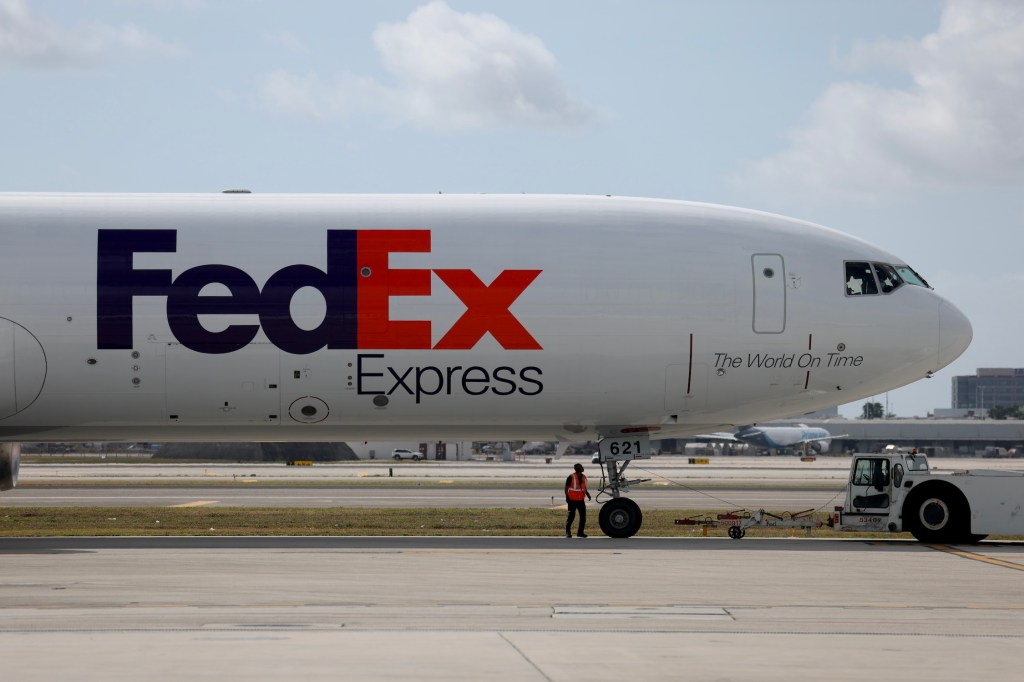
FedEx lowered its full-year guidance for the second time in three months due to what CEO Raj Subramaniam called a “challenging operating environment” in the third quarter that isn’t expected to improve in any time soon.
The Memphis, Tenn.-based courier said it is seeing constrained demand for its higher-margin business-to-business services and is enduring continued weakness and uncertainty in the U.S. industrial economy.
The latter signifies the tepid demand for domestically manufactured goods—a major factor in spurring on the ongoing freight recession and a concern that has partially driven the Trump administration’s “America First” trade policy.
“I think it’s reasonable to assume that the macro environment is not going to significantly improve, at least through the first half of fiscal 2026,” said John Dietrich, chief financial officer of FedEx, in a Thursday earnings call.
FedEx revised its revenue and earnings forecasts downward, with revenue now expected somewhere between flat to slightly down year over year, compared to the prior forecast of approximately flat. Diluted earnings per share of $15.15 to $15.75 is off from the previous expectation of $16.45 to $17.45 per share.
The parcel shipping firm expects capital expenditures of $4.9 billion for the year, down from a previous forecast of $5.2 billion. However, cost reductions via the Drive transformation program are still projected to reach $2.2 billion.
The ominous outlook sent FedEx shares down nearly 10 percent in Friday morning trading.
For the third quarter ended Feb. 28, revenue rose 2.3 percent to $22.2 billion from $21.7 billion. Despite what Subramaniam said was a “compressed” peak season, profit saw improvement as well FedEx posted a profit of $910 million, compared with $879 million in the same quarter year earlier.
FedEx navigated through bottom-line headwinds such as the end of its air cargo contract with the United States Postal Service (USPS) last fall, resulting in a $180 million hit to operating income, Subramaniam said in the call. The CEO noted that this figure will ease in the fourth quarter, and that the company is “continuing to remove costs associated with the expired contract.”
As uncertainty regarding the future of the de minimis provision hovers over U.S. customs and logistics providers, FedEx’s chief customer officer Brie Carere says the company is “very ready from an operational capability perspective.”
“The largest impact would be on customers coming out of the Asia market,” said Carere, noting that FedEx has insight into customs clearance data across global markets. “We’re working very closely with our customers to be able to prepare themselves for any change, whether it’s de minimis or change in market due to tariffs.”
Despite the concerns about tariffs in play since Donald Trump was elected again to the presidency in November, FedEx didn’t see the same pulling forward of freight that ocean carriers did, according to Carere.
“We did not see any significant pull forward in Q3. We did see a little volatility in APAC at the February, early March [period], but for the most part, a pull forward is really hard,” said Carere. “We have not seen that in all the sales calls that I’ve done over the last 90 days. I’ve actually only met one customer who attempted it and they regretted it because they ended up storing some excess inventory.”
However, the tariffs could be further stoking inflation, Carere hinted: “We are talking to a lot of customers who are anticipating that they will increase prices or already have.
Elsewhere in the business, trucking division FedEx Freight saw revenue decline 5 percent to $2.1 billion. The less-than-truckload (LTL) provider’s performance was impacted by fewer shipments, lower fuel surcharges and reduced weight per shipment, partially offset by higher base rates. FedEx Freight is set to be spun off into its own entity by mid-2026.
Since the December announcement of the spinoff, FedEx set up a separation management office for the spinoff, “and established a cross functional team to ensure a smooth transition,” said Dietrich.
The company also unveiled that it was expanding its Sunday residential coverage again based on “demand from our largest customers,” according to Carere. That number expanded to roughly two-thirds of U.S. customers, up from a previous 50 percent.
“We have already received incremental commitments of more than 500,000 packages per week from existing customers tied to our Sunday delivery capabilities,” she said. “This change is enabling us to better utilize our existing assets without adding capacity while meeting the needs of our customers. As a result, we expect this incremental coverage to be profit accretive in Q1 of fiscal year 2026.”
FedEx previously offered Sunday home delivery to nearly 95 percent of the U.S. population prior to 2022, but scaled back coverage due to high costs and complaints from contractors. However, demand for home delivery has been one of FedEx’s recent strong suits, with U.S. ground home delivery and economy services growing 11 percent year over year in the quarter.