Physical Address
304 North Cardinal St.
Dorchester Center, MA 02124
Physical Address
304 North Cardinal St.
Dorchester Center, MA 02124

The greatest, the least, and others in between.
The greatest, the least, and others in between.
Escalating tensions between the U.S. and the Houthis in the Red Sea are fostering even more uncertainty for container shipping and its return to the waterway.
On Saturday, U.S. Central Command initiated large-scale precision air strikes against the Yemeni militant group just days after the designated terrorist organization threatened to resume attacks on Israeli vessels traveling through the region.
“The Houthi attack[s] on American vessels will not be tolerated. We will use overwhelming lethal force until we have achieved our objective,” said President Donald Trump in a post on Truth Social upon ordering the military action. “The Houthis have choked off shipping in one of the most important Waterways of the World, grinding vast swaths of Global Commerce to a halt, and attacking the core principle of Freedom of Navigation upon which International Trade and Commerce depends.”
According to Houthi media, the air strikes resulted in 53 deaths, including several children, and more than 100 injuries. The attacks hit targets in Yemen’s capital, Sanaa, as well as the northern governorate of Saada and the port of Hodeidah.
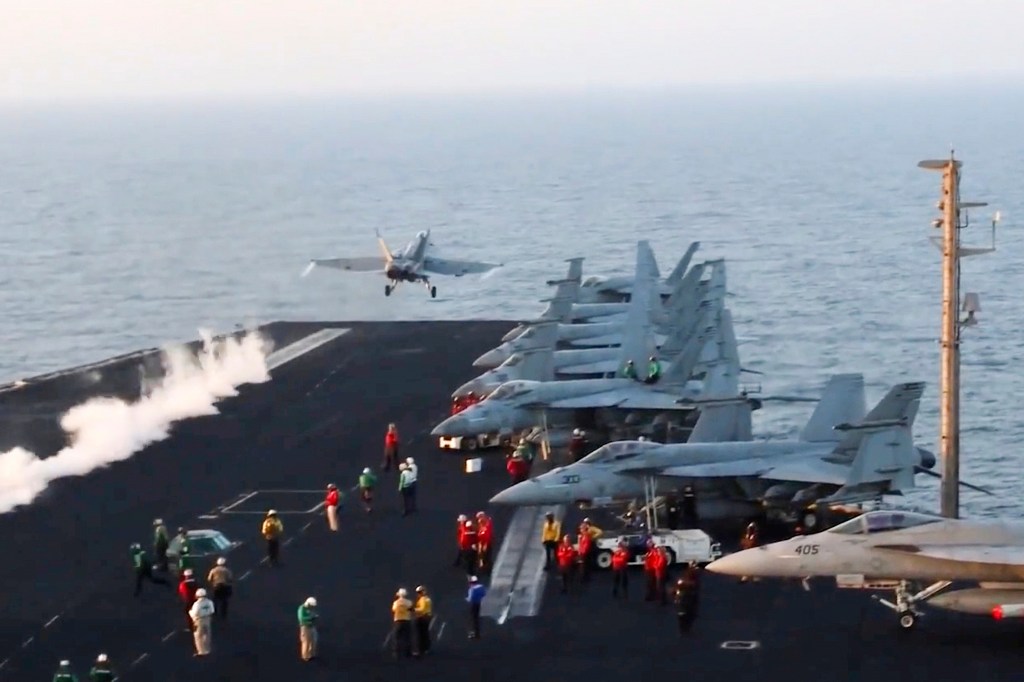
In response, the Houthis claimed two attacks on the U.S. aircraft carrier USS Harry S Truman and its warships on early Monday. Various reports indicate a U.S. official said the Houthis fired 11 drones and one ballistic missile, none of which came close to hitting any U.S. vessels.
A statement from Yahya Sare’e, the military spokesperson of the Yemeni Armed Forces, said the Houthis are “confronting this criminal aggression and responding to escalation by escalation.”
The resumption of U.S. airstrikes increases the likelihood of further Houthi attacks on U.S. and allied naval assets in the region, says Jack Kennedy, head of MENA country risk at S&P Global Market Intelligence. Kennedy said the uncertainties around Houthi targeting selection carries “a severe risk to all vessels in transit.”
“Our data shows that 63 percent of vessels targeted by the Houthi lack any clear affiliation to the U.S., U.K. or Israel,” said Kennedy. “While the stated US intent is to restore freedom of navigation, the Houthis’ decentralized missile capabilities and intent to assert regional influence complicate the situation, likely leading to increased threats to shipping and regional stability.”
From November 2023, all throughout 2024, the Yemen-based Houthis launched missile and drone attacks against commercial vessels sailing through the Red Sea, its chokepoint, the Bab el-Mandeb Strait, and the neighboring Gulf of Aden. This resulted in a massive dip in traffic through the Suez Canal and lengthened East-to-West ocean shipping times as major carriers committed to rerouting their ships around southern Africa’s Cape of Good Hope.
The Houthis had stopped the attacks after Israel and Hamas entered into a ceasefire, but had claimed they would begin the onslaught again if Israel did not lift a blockade of aid to Palestinians in the Gaza Strip.
According to a Monday report from Reuters, “war-risk” insurance premiums are likely to stay at firmer levels and may rise in coming days, further preventing container shipping companies from making a return to the Red Sea.
War risk premiums briefly eased to around 0.5 percent of the value of a ship after the January ceasefire from over 0.7 percent in December, before moving higher in February to 0.7 percent for some voyage rates. For some U.S. and U.K. linked ships, rates were quoted up to 2 percent in recent weeks, Reuters said.
Munro Anderson, head of operations at marine war risk and insurance specialist Vessel Protect, told the publication there was a “significant uptick in the threat profile against commercial maritime traffic within the Red Sea.”
As a new page in the Red Sea drama continues to unfold, the Suez Canal is the subject of an investigation recently opened by the Federal Maritime Commission (FMC), which is looking into whether transit constraints at international trade chokepoints have created unfavorable shipping conditions for cargo movement.
The FMC will investigate the Suez Canal, as well as the English Channel, the Malacca Strait, the Northern Sea Passage, the Singapore Strait, the Panama Canal and the Strait of Gibraltar.
According to the commission, the probe is examining whether the laws, regulations, or practices of foreign governments or the practices of foreign-flag vessel owners or operators have contributed to the “unfavorable” conditions.
Trade and shipping law firm Sandler, Travis & Rosenberg noted in a Monday advisory that the move appears to be part of the Trump administration’s effort to reduce U.S. reliance on foreign-owned cargo ships. President Trump already told Congress this month that he would create an Office of Shipbuilding in the White House, and offer tax incentives to bring the industry back to the U.S.
The agency can take multiple remedial measures if it finds wrongdoing, such as refusing vessels entry to U.S. ports if they are registered in a country responsible for creating the unfavorable conditions.
The only chokepoint operator with a large flag registry is Panama, which has more than 8,000 vessels sailing under the country’s flag.
Additionally, the FMC can impose fees up to $1 million per voyage, suspend an ocean common carrier’s right to operate under any agreement filed with the FMC and conduct investigational hearings.
Any discussion of remedial measures would occur after collecting information, perspectives and proposed solutions to the concerns. Stakeholders can submit their commentary through May 13.
The FMC’s agenda fits in alignment with the Trump administration’s America First trade policy, and the U.S. Trade Representative’s proposal to levy fees on Chinese-built and -operated vessels. Those fees could cost some carriers as much as $1.5 billion, and were recommended after the USTR found that China’s maritime, logistics and shipbuilding practices were “unreasonable” under Section 301 trade laws.
Trump-appointed FMC chair Louis Sola told the Financial Times that the U.S. should “fight fire with fire” and impose fees on those vessels to fund subsidies for U.S. shipbuilders. Sola noted that the FMC had assisted the USTR in its nine-month probe into the Chinese industries.
The Trump administration is expected to make a final decision on the proposal after a public hearing in March.
As many as 36,595 U.S. port calls in 2024—an astounding 83 percent of container ship stops—could have been affected by the USTR’s proposed recommendations, according to Clarksons Research. That would generate an annual fee income between $40 billion and $52 billion.