Physical Address
304 North Cardinal St.
Dorchester Center, MA 02124
Physical Address
304 North Cardinal St.
Dorchester Center, MA 02124

The greatest, the least, and others in between.
The greatest, the least, and others in between.
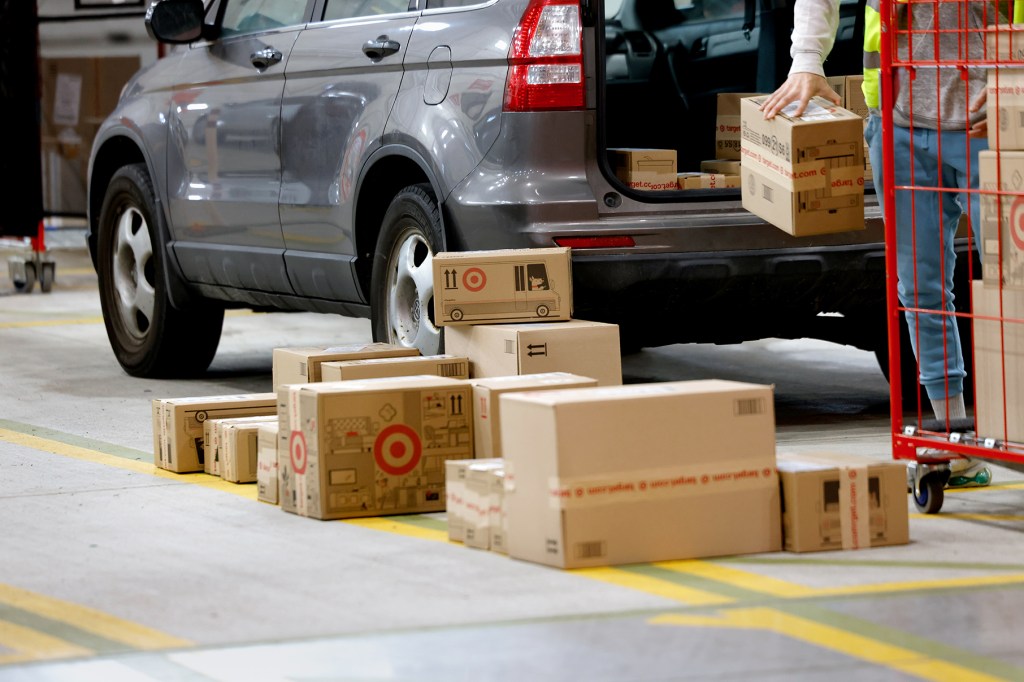
Just days after acquiring a 96-acre distribution center near Denver for $231 million, Target celebrated another supply chain victory as it continues to shorten the last mile.
While softness in consumer spending to kick off February dragged down the mood for the mass merchant at its investor day on March 4, the company remains bullish about the expectations of its “stores-as-hubs” fulfillment strategy in 2025.
The stores appear to be covering wider ground for Target’s delivery operation, with same-day delivery growing more than 25 percent compared to last year. Same-day delivery normally carries a fee for eligible items, but is free for orders above $35 for members of the Target Circle 360 paid membership program.
Average delivery times were 11 percent faster in 2024, even as Target’s network is getting flooded with more packages. The retailer nearly doubled its packages delivered next-day over 2023.
“While our in-store shopping is what made Target famous—and yes, it’s the most profitable on average—our digital channel is profitable as well and continuing to get even more efficient over time,” said Cara Sylvester, the chief guest experience officer at Target.
The expedited pickup and delivery offerings are enticing shoppers to spend more, both online and in stores. Users of Drive Up and same-day delivery spend more than 20 percent more on average, according to Sylvester.
And while Target took a hit in the prior quarter for unexpected supply chain costs related to the three-day East and Gulf Coast port strike in October, the company doesn’t expect any margin headwinds in the supply chain in the back half of the year. However, the retailer didn’t get out of the fourth quarter without any added expenses, with gross margins dipping 0.4 percentage points on higher digital fulfillment and supply chain costs.
The Minneapolis-based retail giant, like chief competitor Walmart, has continued to pour money into its supply chain infrastructure as its e-commerce business expands.
Target invested $100 million starting in 2023 to accelerate the company’s next-day delivery capabilities by scaling its fleet of sortation centers, most recently opening an 11th such U.S. facility in Detroit late last summer.
Packages delivered from sortation centers by Shipt drivers increased 30 percent in 2024, according to chief operating officer Michael Fiddelke, who said “that just means a lot more packages delivered in a more cost-efficient manner.”
While the buildout of its sortation center network has helped the mass merchant make faster deliveries, Target is now piloting a delivery program in areas without the facilities. In this pilot, Shipt drivers can work delivery routes directly from stores, dropping off packages on a single route to multiple consumers.
“While we’re in the early stages of expanding this test to more markets, we’re very encouraged by the early results as it’s making us faster and more cost efficient,” Fiddelke said.
While Target already has a sortation center in Denver, the retailer recently acquired a soon-to-be- constructed distribution center in nearby Thornton, Colo.
The property includes an approximately 529,000-square-foot freezer and cooler distribution warehouse, as well as 99 loading docks. Development of the site began in 2023 and the warehouse project is anticipated to conclude by the end of March.
As Target adds to its supply chain footprint, the company also expressed its desire to shorten product lead times to reduce inventory risk, particularly in its longest lead apparel and home categories. The company wants to cut product lead times namely due to a 7 percent year-over-year increase in inventory costs.
According to Target’s chief financial officer Jim Lee, the retailer is looking to pull 20 percent of its lead times out of apparel.
The retailer is leveraging AI technology dedicated to improving the business’s inventory planning and purchasing across the supply chain, using an “inventory-not-found” modeling system to predict the availability of products in a store. The tools are designed to enable more accurate forecasting and help Target better position inventory to drive in-stock speed and reduce costs.
“These new systems are now used by about 40 percent of the assortment,” Fiddelke said. “That’s more than double the percentage that use them in 2023, progress we expect to continue in 2025 and beyond.”
Target’s supply chain ambitions for 2025 were overshadowed by fourth quarter results that surpassed expectations but remained largely uninspiring.
Fourth-quarter sales for Target fell 3.1 percent to $30.9 billion, but were up against a year-ago period that included an extra week. Comparable sales grew 1.5 percent.
Net income fell 20.2 percent to $1.1 billion, or $2.41 per diluted share, from last year’s $1.4 billion holiday, or $2.98 per share.
The next year isn’t expected to impress, with net sales growth expected to reach 1 percent on “around flat” same-store sales growth. Earnings per share is forecast to be within a range of $8.80 to $9.80.